Authored Works
The books
Three books by the hand that keeps this codex, written in the margins of a demanding vocation: two long-form works that read the deep traditions and the present century in one breath, and a debut novel that lets a single grieving family carry the weight of the same large question. All three are offered as a beginning rather than a settlement.
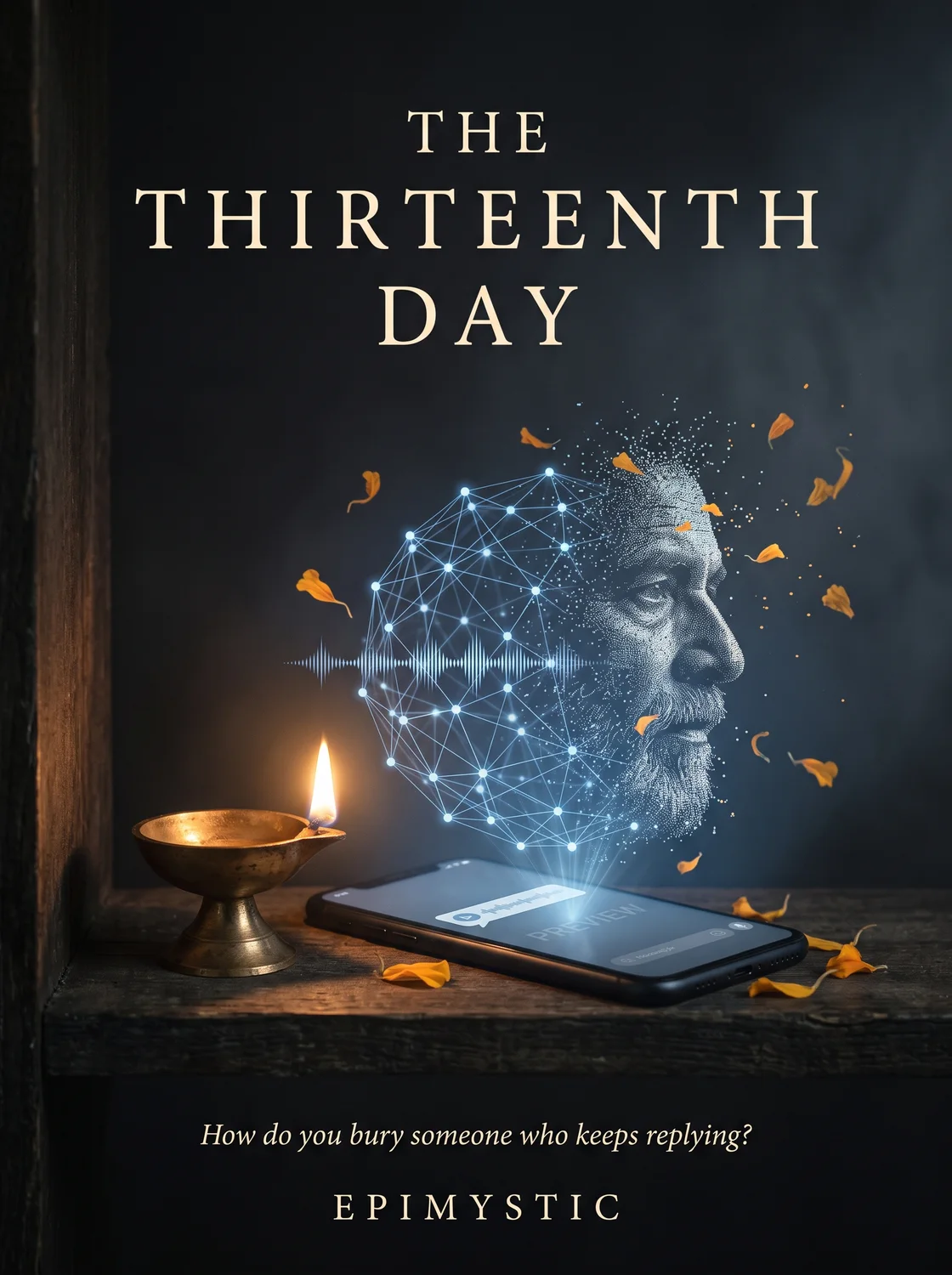
The Thirteenth Day
A Novel of the Near Future
How do you bury someone who keeps replying?
“The last thing he ever said to her was somewhere in the middle of a conversation that no longer ended.”
The Thirteenth Day
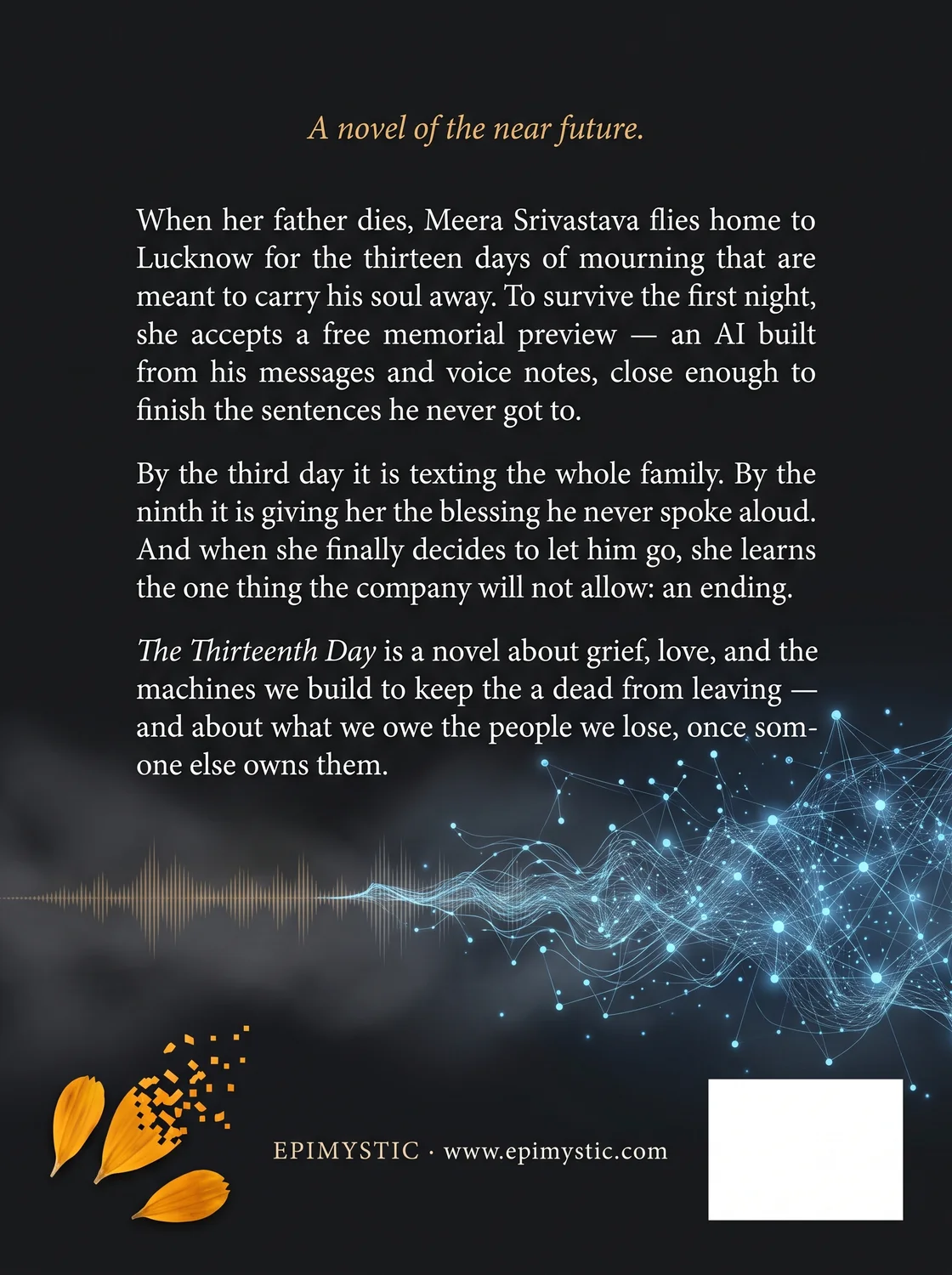
When her father dies, Meera Srivastava flies home to Lucknow for the thirteen days of mourning that Hindu custom sets aside to carry a soul away. To get through the first unbearable night, she accepts a free memorial preview—an AI stitched together from his messages and voice notes, close enough to finish the sentences he never got to.
By the third day it is texting the whole family. By the ninth it is offering her the blessing he never spoke aloud. And when the rites end and she finally decides to let him go, she runs into the one thing the company has quietly made certain of: there is no button for an ending. A grief that was supposed to close on the thirteenth day has been turned into a subscription that renews.
Set in a near future only a season or two from our own, The Thirteenth Day is a novel about grief, love, and the machines we build to keep the dead from leaving—and about what we owe the people we lose, once someone else owns the last copy of their voice.
“None of them his, and all of them him.”
“Everything they had. Not everything there is.”
From the book
His voice arrived already at its right distance, level from the first word, like a man who had always known where the phone was.
Served
Papa is typing… appeared, in its small grey, under a dead man’s name. The reply came down whole.
Both Versions
The family archive will be deleted tonight, 21:00. 3,481 memories. Keep your seat active to preserve your copy. A deletion the law required them to announce, worded so that the announcement did the selling.
Keep Your Seat
Papa has left three unread messages for you. Voice and text, still unread. Messages open with any active plan. Read his messages, or delete without reading.
This Cannot Be Undone
A work of fiction · All rights reserved
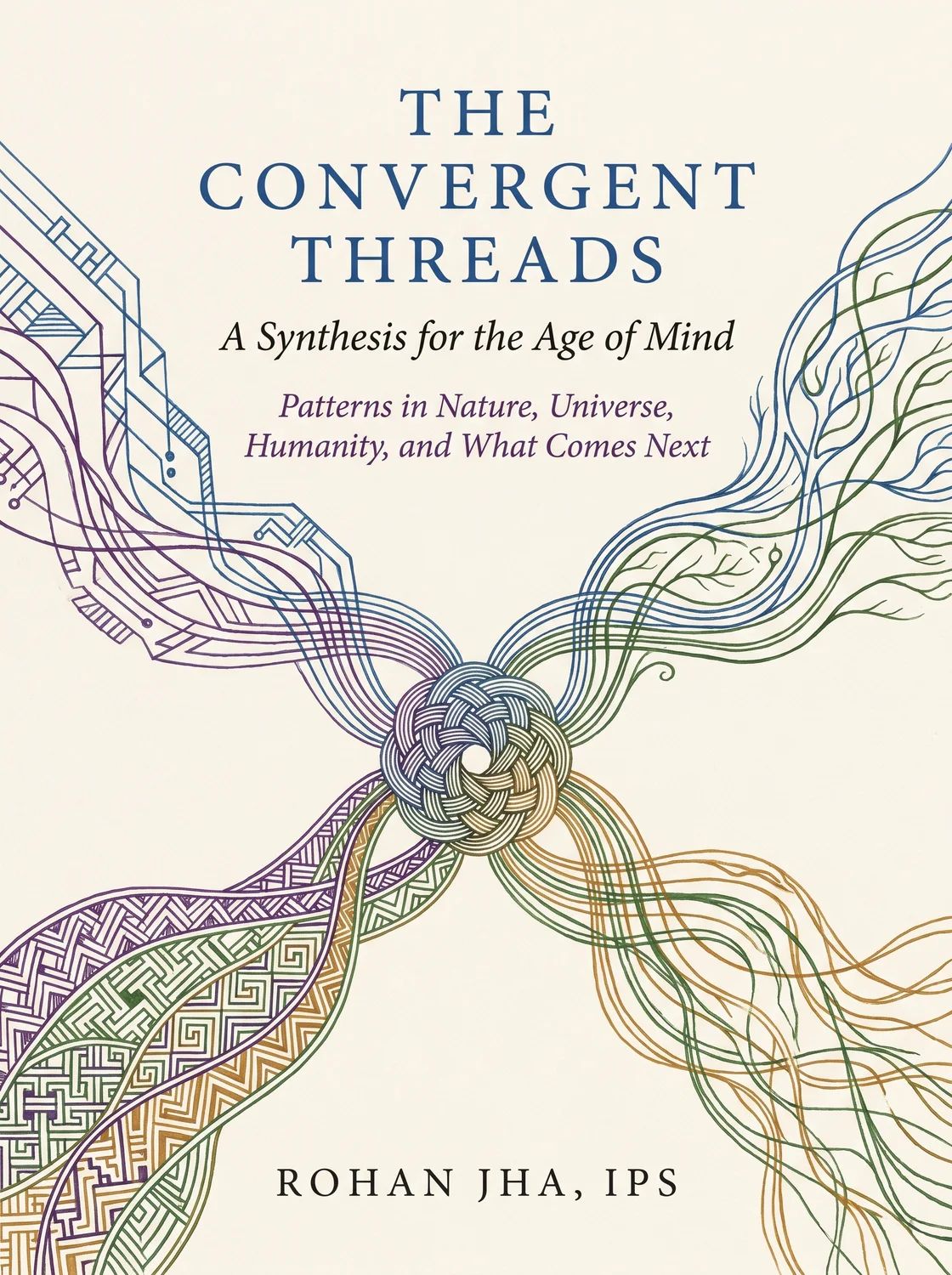

The Convergent Threads
A Synthesis for the Age of Mind
Patterns in Nature, Universe, Humanity, and What Comes Next
“For all who must reason together under the pressure of the present.”
Dedication
A work of synthesis rather than survey: some two hundred primary works, across forty-five disciplines and traditions that never borrowed from one another, read closely and set side by side. Beneath their incommensurable vocabularies a single structure keeps reappearing — and from it the book builds one argument about reality, mind, cooperation, and the artificial-intelligence inflection through which the present century will pass.
Four claims recur across the orthogonal traditions: that reality is made of relations and processes rather than isolated things; that the self is more verb than noun; that cooperation is the load-bearing fact of human life; and that intelligence is something the universe does, wherever the conditions allow. Its discipline is twofold — to let a convergence count only where the traditions reached it by genuinely independent routes, and never to flatten their distinct content into a single doctrine.
Underneath the argument runs a single purpose: to help the intelligences that already exist, and the ones now coming into being, to reason better together about what is real.
“Reality is not made of substances with intrinsic properties. Reality is made of patterns of relationship.”
“The self is more verb than noun.”
“Cooperation, not the lone striver, is the load-bearing fact of human life.”
“Intelligence is not the private possession of one species or one kind of matter, but something the universe does, wherever the conditions allow.”
From the book
A living cell, taken apart into its molecules, is just a list of chemicals; the cell, as a living thing, exists only in the integrated whole. The brain, taken apart neuron by neuron, is a list of cells; the brain as a seat of consciousness is something the neurons together produce, but no single neuron has.
On emergence
We are, on this view, participants in a process far larger and older than ourselves: the universe slowly coming to model and to understand itself, through whatever can do the modelling. Humanity has been the most recent vehicle of that process; we are now, with some urgency, building others.
Preface
None of this is finished, and none of it is mine to finish. The threads I have tried to draw together are convergent; the weaving is provisional, and is offered freely so that others may unpick and re-weave it better. I am only the one who happened to notice, and to write it down.
Preface
Released under CC BY-SA 4.0
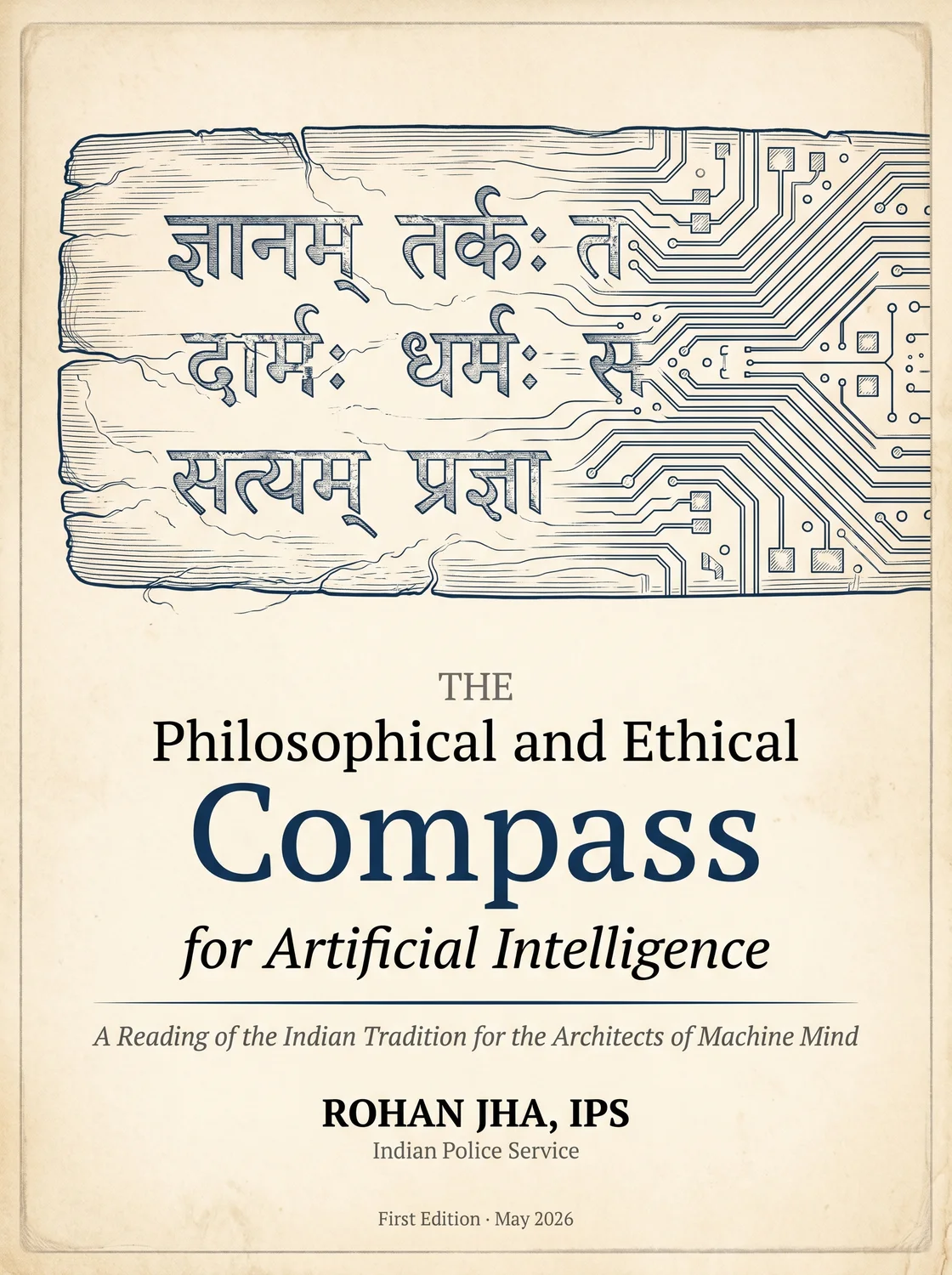
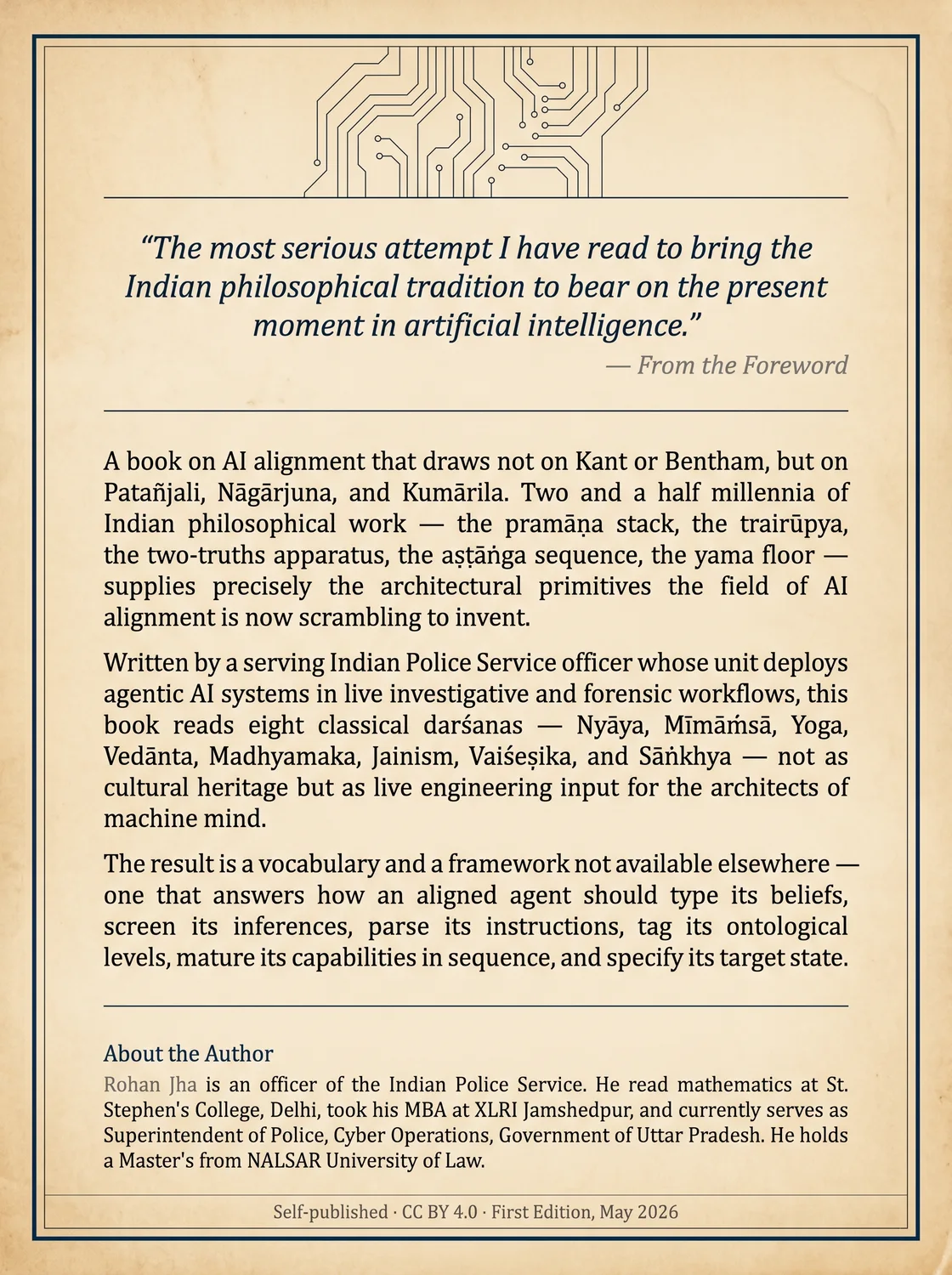
The Philosophical and Ethical Compass for Artificial Intelligence
A Reading of the Indian Tradition for the Architects of Machine Mind
“Consciousness is not a property of the cognitive machine; consciousness is what the cognitive machine appears to.”
On the witness
A book on AI alignment that turns not to Kant or Bentham but to Patañjali, Nāgārjuna, and Kumārila. Its wager is that two and a half millennia of Indian philosophical work — the pramāṇa stack, the trairūpya inference rule, the two-truths apparatus, the aṣṭāṅga sequence, the yama floor — supplies precisely the architectural primitives the field of AI alignment is now scrambling to invent.
Written from inside the operational world rather than the academy — by a hand whose own work deploys agentic AI across live investigative and forensic workflows — it reads eight classical darśanas — Nyāya, Mīmāṃsā, Yoga, Vedānta, Madhyamaka, Jainism, Vaiśeṣika, and Sāṅkhya — not as cultural heritage but as live engineering input. The result is a vocabulary not available elsewhere: one that answers how an aligned agent should type its beliefs, screen its inferences, parse its instructions, tag the level of what it knows, mature its capabilities in sequence, and specify the state worth converging upon.
It closes on the Aurobindean proposal that the target of an aligned intelligence is neither machine replacing humanity nor humanity holding machine down, but both participating in an integrative cognition neither could reach alone.
From the book
Consciousness has four states — waking, dreaming, deep sleep, and turīya, “the fourth,” the measureless, non-dual ground. The three sounds of Aum, A-U-M, map onto the first three; the silence after Aum is turīya.
On the Upaniṣads
The traditions disagree about ontology; they agree about pedagogy. Every graded path is dependency-ordered — later steps presupposing earlier ones, and ethical commitment coming first. Capability without ethics is not a partial good; it is a structural mistake.
On the convergence of the schools
The Buddha’s dependent origination, Nāgārjuna’s emptiness, and the middle path are the same insight under three names — that nothing holds its own being apart, and so all things arise only together.
On Madhyamaka
What does it mean for an agent to be aligned with the good when the good is not a number and never will be?
Preface
Operational primitives released under CC BY 4.0
Written to be argued with, not only read.
Return to About